
When a pet goes missing: understanding DogID, CatID and UFoundMe!
Identifying an animal, reaching the person who cares for them and supporting the person waiting for news: three different needs that should never be set against one another.
Editorial team: UFoundMe! by MEOSafety
Behind a missing pet is a person who is worried
When a dog does not come back or a cat goes missing, the first question is not technical: where are they, and are they safe?
A disappearance leaves questions unanswered: you search, you hope and you wonder whether you have looked in the right place.
Worry can be accompanied by guilt; that distress deserves recognition, not dismissal.[en-1]
A missing pet is not a pet whose death has been confirmed: support the person without asking them to give up the search.
Understanding identification tools then serves a practical purpose: knowing whom to notify and what to do.
DogID and CatID: official identification and finding the registered keeper
DogID and CatID are Belgium’s official registration databases for dogs and cats, commissioned by the three Regions.[en-2]
The implanted microchip carries a unique number; registration links that number to the animal and their registered keeper. Contact details are stored in the database.[en-7]
The chip requires a suitable scanner, not a phone’s NFC function; it is not a GPS device and cannot show the animal’s movements on a map.[en-3]
These registers already help identify and reach the registered keeper: access to contact details is controlled, and authorised professionals can consult them for that purpose.[en-4][en-6]
An ID tag does not replace the legal requirement
In Belgium, dogs must be identified and registered; DogID states that a puppy you keep must be registered before eight weeks of age, and that identification and registration must precede any sale or gift.[en-4]
Cats are also subject to regional microchipping and registration requirements; possible exceptions, including those linked to age or earlier registrations, should be checked with a vet.[en-5][en-6]
Where official identification is required, a collar, an ID tag or an online profile is not enough: identification and registration remain necessary.[en-4][en-5]
Having the chip implanted is not the final step: check that registration is complete and update contact details after moving home or changing your phone number.[en-7]
UFoundMe!: an additional way to make contact
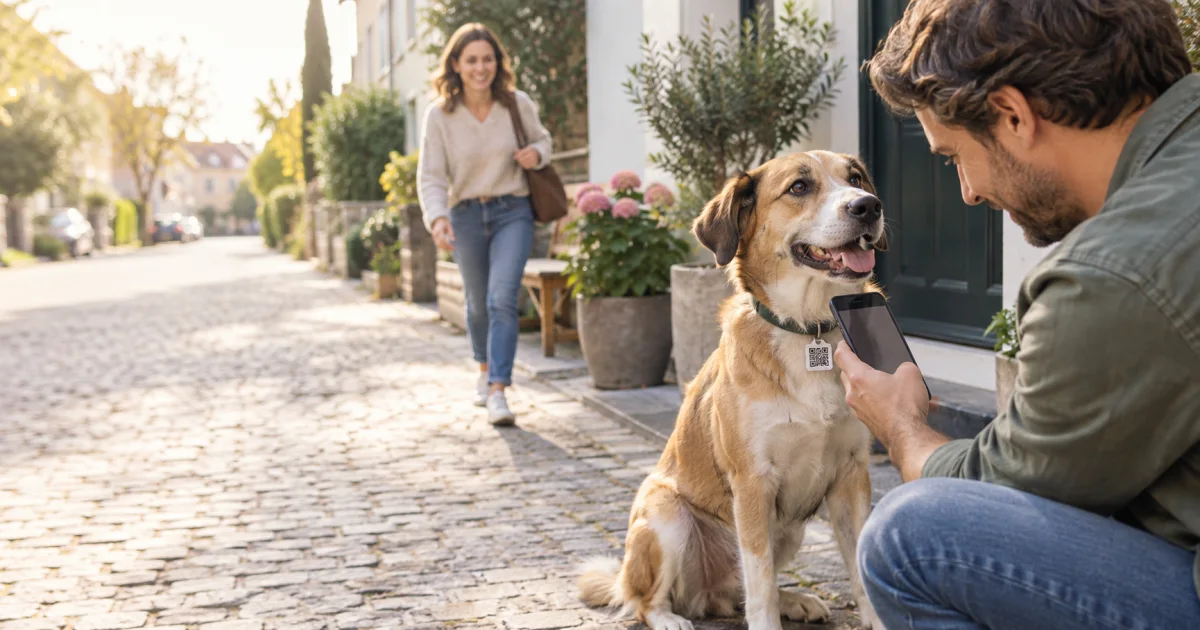
UFoundMe! is a private contact service, not an official register. According to the description supplied by its operator, a QR/NFC tag opens a pet profile and a messaging service.[en-8]
The finder uses an internet-connected smartphone, with no app to install; the service is designed to enable messaging without making the owner’s phone number public.[en-8]
This requires the tag to be present and readable, the profile to be activated and the service to be accessible. The tag can be lost and provides no GPS tracking: someone must scan it.[en-8]
That contact complements the microchip; it does not replace procedures in DogID/CatID, a missing-pet report or professional checks where there is uncertainty.[en-4][en-6]
The vet: identification, care and guidance
A vet does more than implant a microchip: they can check that it can be read and help verify registration, particularly when the number cannot be found in the database.[en-9]
If a recovered animal is injured, very weak or appears unwell, seek veterinary advice without waiting for an online conversation to produce a result.[en-10]
An animal shelter or the local police can also help find the registered keeper; remember, however, that a cat encountered outdoors is not necessarily missing.[en-11]
No tool guarantees a reunion: reliable information and people available to help remain essential.
Older adults: offer support while respecting independence
The everyday bond with an animal can be deeply important; when an older person lives alone, take time to understand what the absence changes for them.[en-12]
Age alone does not tell us whether someone can use a phone or organise a search: first ask what support the person would welcome.
If mobility, fatigue or online procedures become a barrier, offer practical help: a relative making calls, a neighbour searching or someone accompanying them to the vet.
Prepare a paper information sheet together, including a recent photo, the microchip number, useful contacts and a trusted person to notify; this avoids having to organise everything during a stressful moment.
Arrange that support with the person’s agreement, without taking decisions away from them or assuming that an app replaces human presence.
Act together rather than leave someone waiting alone
When a pet goes missing, notify the relevant local contacts, report the animal in the appropriate register and check that contact details are current.[en-9]
DogID provides several reporting channels; CatID specifies that a report must be made through its platform or a vet, not simply by phone or email.[en-4][en-6]
Share the tasks and agree when to provide updates: the person waiting for news should not have to carry the entire search alone.
Identifying the animal, enabling contact and supporting their person are three complementary responsibilities. None should make us forget the other two.
Sources and references
Public sources consulted on 10 September 2026. The British references explain microchip technology or support after loss; they are not the basis for the Belgian legal requirements.
Information note
This article concerns dogs and cats in Belgium, not all species or countries. Exact obligations depend on regional rules and the animal’s circumstances, including earlier registrations or arrival from abroad. Consult your vet and the competent authority for an individual case. The suggestions for supporting older adults are practical guidance to adapt to their wishes, not a clinical assessment. This article is neither individual legal advice nor veterinary advice. Mentioning DogID and CatID does not imply that they endorse UFoundMe!
- Associated Press, John Leicester, “Losing a pet can cut deeper than many people realize. Here’s how friends can help”. Experiences and interviews on distress and guilt following loss, including disappearance. ↩
- DogID and CatID, official DogID introduction and official CatID introduction. Mandate from the three Regions and role of the registers. ↩
- Cats Protection, “9 myths about microchipping”, section on the absence of GPS; Vlaanderen, dog identification, use of a microchip scanner. ↩
- DogID, frequently asked questions, French version. Identification and registration requirements, contact details and reporting a lost or stolen dog. Some historical tattoo identifications remain recognised. ↩
- Vlaanderen, cat identification and registration. Flemish rules and historical exceptions; this page alone should not be extrapolated to the other Regions. ↩
- CatID, keeper FAQ, French version. References to regulations in all three Regions, data access, missing-pet reports and veterinary assistance. ↩
- RSPCA, how microchipping works. Identification number, database link and the need for current contact details. ↩
- UFoundMe!, functional description supplied by the operator for this article. QR/NFC tag, profile and private messaging, connected smartphone, activation and absence of GPS. An operator-supplied description, not an independent assessment of the service. The website could not be accessed during this check; no performance or reunion guarantee is verified here. ↩
- Vlaanderen, checking records in DogID and in CatID. Checking the chip, registration and status, with veterinary assistance. ↩
- RSPCA, “Find or call a vet”. Seeking veterinary care when an animal is suffering; a care reference, not a source of Belgian law. ↩
- DogID, found dog, and CatID, found cat. Finding the registered keeper through appropriate services; an animal encountered is not necessarily abandoned or missing. ↩
- RSPCA, “Pet bereavement toolkit”. Recognition of the emotional bond and distress after loss. A general reference: it does not establish any individual older person’s experience or imply that a missing animal has died. ↩