
Older dogs: adapt walks and keep the enjoyment
Pace, routes, weather and rest: practical ideas for adapting walks to your older dog and discussing everyday changes with your vet.
Start with your dog, not a number
AAHA’s veterinary guidelines do not set one age at which every dog becomes a senior: ageing varies, including between breeds. A birthday alone is therefore not enough to choose a walking routine.[en-1]
Imagine two neighbours discussing their dogs, who happen to be the same age. One talks about country lanes; the other describes a circuit of the local square. These are two different daily lives, not targets to copy. To prepare for a conversation with your vet, describe an ordinary outing instead, from leaving your front door to coming home. This article is about organising that shared time without setting a universal number of minutes or kilometres. Someone else’s favourite walk does not have to become your starting point.
Give the walk a flexible shape
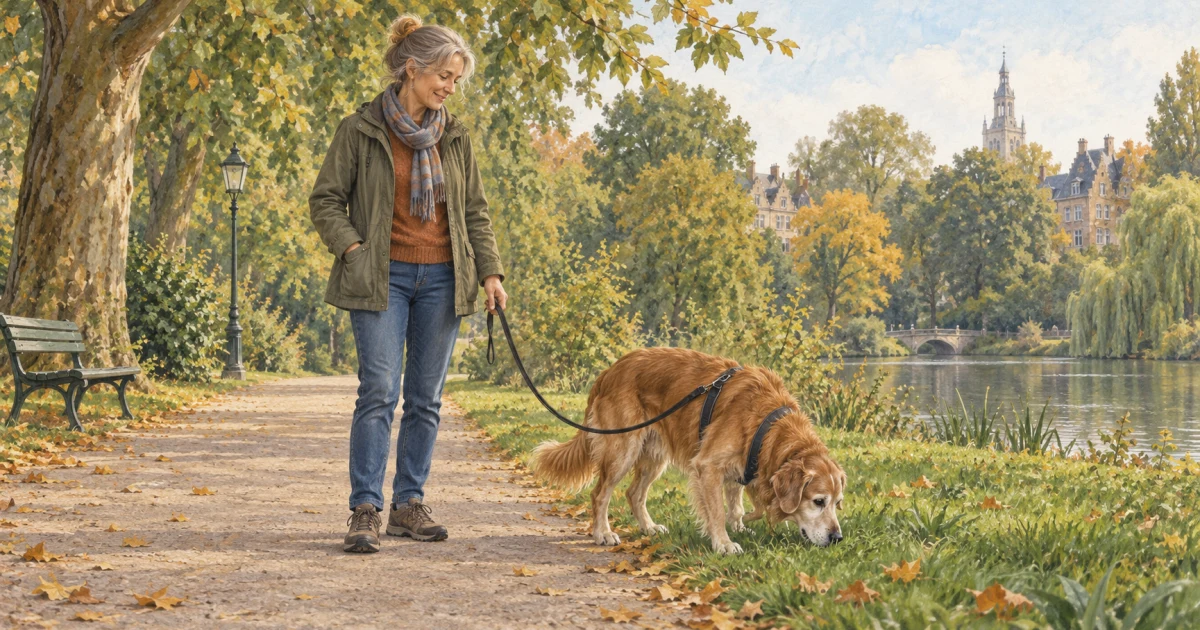
Dogs Trust advises letting an older dog set the pace and choosing short, frequent walks rather than one long outing. Dogs still need movement, even when lengthy hikes no longer suit them.[en-2]
You might put ‘walk with Oslo’ in your diary without committing to reaching the bandstand. Choose somewhere you can easily turn back before setting off. This stops your planned coffee on the far side of the park becoming an obligation for your companion. If family members take turns walking the dog, describe the route simply: ‘We went as far as the first junction.’ That tells the next person what happened without turning the walk into a family competition over who managed the longest distance.
Look at the path before the distance
The PDSA recommends checking that a route suits your dog’s fitness and avoiding very steep or difficult sections. It advises against throwing games for older dogs, because rapid acceleration and sudden stops place strain on their joints.[en-3]
On a neighbourhood map, two equally short loops can be very different: one includes a staircase, while the other follows an avenue. Explore an unfamiliar place without your dog first if that helps you plan. Make a note of the entrance you intend to use, too, so you are not improvising a detour at the last moment. Knowing the path makes a simple decision possible: today we will follow the avenue; the bigger circuit can wait. Choosing a route does not replace advice from your vet.
Plan for the day you actually have
According to the PDSA, older dogs cope less well with very high or low temperatures. Familiar places can also help when sight or hearing declines. Respect your dog’s limits and do not push them to continue.[en-4]
During a Belgian autumn, take a moment to look at conditions outside your home rather than automatically following the plan you made on Sunday. A walking arrangement can change; the group does not need to set your dog’s pace. Tell friends and family beforehand: ‘We’ll choose our route when we set off, and we may come home earlier.’ That gives you room to adapt without explaining every change. Even when everyone is enthusiastic about a particular destination, you can still reconsider what you have arranged together.
Leave room for curiosity
Dogs Trust explains that enrichment should suit a dog’s health, abilities and preferences. Watch their interest and frustration, and simplify an activity when necessary. Giving dogs safe choices is another way to provide enrichment.[en-5]
Your own account of the walk can change, too. Instead of remembering only which street you covered, describe what caught your dog’s attention. ‘They paused beside the hedge’ is already a little story to share. You do not need a new accessory for every outing or a whole sequence of exercises prepared in advance. Leave some time to notice what interests your companion, within the limits of the setting and their health. Walking can remain an appointment with your dog, with room for whatever you discover along the way.
Include the journey back into the house
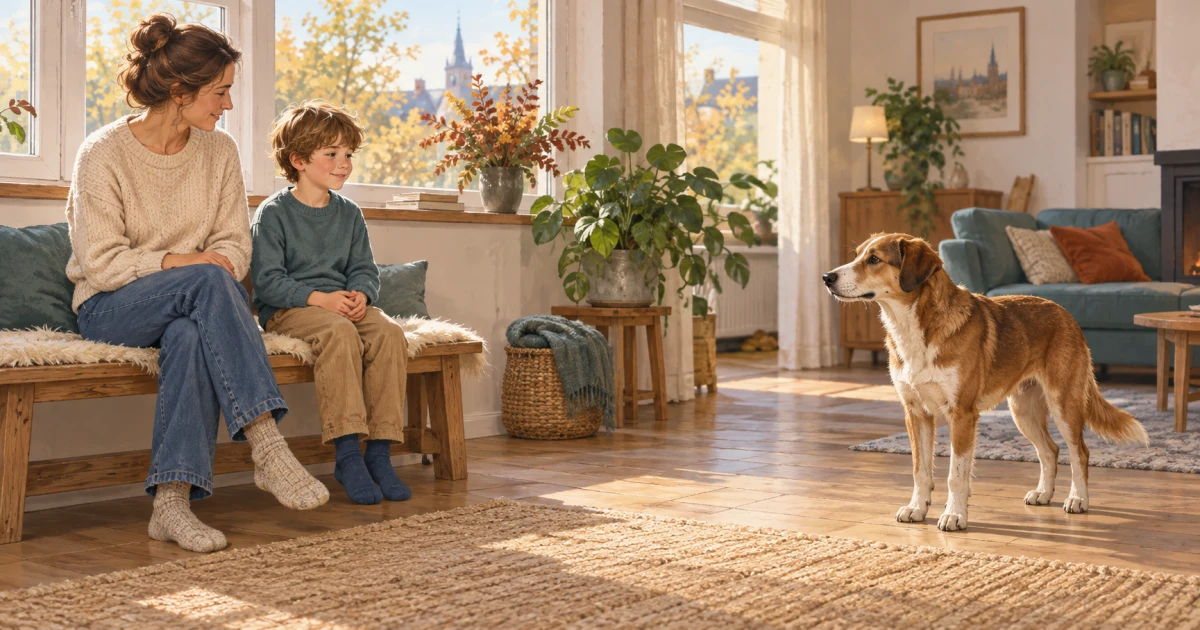
The RSPCA recommends a quiet resting place, easily accessible essentials and flooring with good grip. Older dogs should be able to rest without interruption from visitors or other animals, with fresh drinking water available.[en-6]
Think of arriving home as the final part of your route. If friends are due then, explain beforehand where your dog likes to retreat. Put your own bags and shoes away so you do not absent-mindedly leave them in that passage. At home, agree who will greet visitors and who will take off the lead. This small division of tasks avoids everyone gathering around the dog in the hallway. There will be time to enjoy each other’s company later; it does not all have to happen as the front door opens.
Turn observations into useful questions
AAHA points out that changes attributed to ageing may actually involve chronic pain, which can be subtle. A video of everyday movement can help a vet assess changes. Discuss differences in mobility or behaviour rather than deciding on a diagnosis yourself.[en-7]
Prepare a short note covering what you saw, when it began and the situation in which it happened. ‘They have hesitated at the doorstep since Tuesday’ is more precise than ‘they are getting old’. Ask your vet what kind of outing is appropriate now and which changes should prompt another call. Do not create a difficulty just to film it. Your part is to describe everyday life; your vet’s is to assess your dog’s health and suggest suitable care. Together, you then have something more concrete to work with than a general impression.
Sources and background
Sources consulted on 13 October 2026. General guidance to discuss with your vet; no UK legal requirements are applied to Belgium. The planning examples are original editorial suggestions.
- AAHA, Defining the Senior Patient. 2023 AAHA Senior Care Guidelines for Dogs and Cats (2022-12-13). ↩
- Dogs Trust, Caring for an older dog. ↩
- PDSA, Exercise for dogs. ↩
- PDSA, Exercising your senior dog. ↩
- Dogs Trust, Enrichment activities to keep your dog entertained. ↩
- RSPCA, Caring for older dogs. ↩
- AAHA, Pain Management. 2023 AAHA Senior Care Guidelines for Dogs and Cats (2022-12-13). ↩