
Indoor cats: simple ways to enrich everyday life
Hiding places, scratching surfaces, short games and food puzzles: simple ways to enrich your indoor cat’s daily life while respecting their preferences.
September often brings busier diaries. If you share your home with a cat, it is a useful moment to look at the living room differently: what does it offer your cat on an ordinary day? The answer is not measured by the number of toys you have bought. An indoor environment needs to support natural feline behaviour and meet physical as well as emotional needs.[en-1]
Here is an approach you can adapt to your home, in Belgium or elsewhere. It needs neither an extra room nor a compulsory shopping list. Start by identifying one possible improvement, then watch what your cat makes of it.
Start by watching, without making it a test
For a few days, jot down where your cat chooses to rest, what catches their attention and which invitations they ignore. A small notebook will do: ‘box used in the morning’, ‘toy ignored after lunch’. These observations do not provide a diagnosis. They can help you choose your next experiment without relying only on an accessory’s packaging.
Provide a retreat and accessible resources
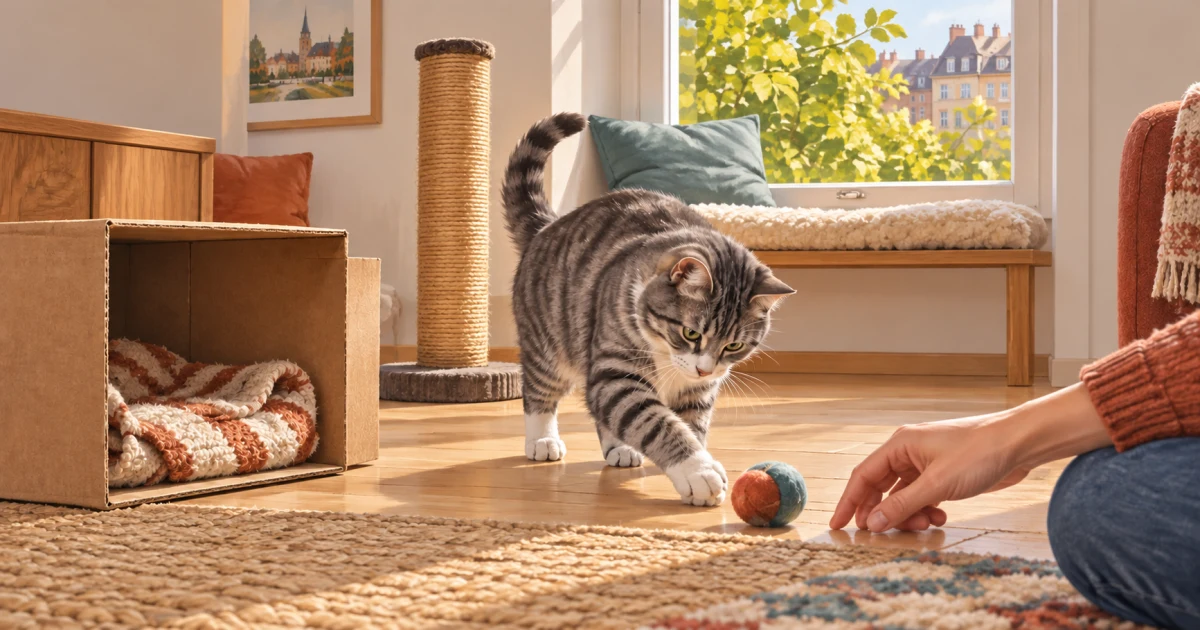
A suitable cardboard box, an open carrier or a raised resting place can offer a refuge. Your cat should be able to find peace there. The FelineVMA also recommends separating essential resources, food, water, litter, resting and scratching areas, and respecting the cat’s choices about contact with people.[en-2]
In homes with several cats, each needs their own resources and places to retreat. Putting all the food bowls together does not meet that need. Check household hazards too: accessible wires, toxic plants, medicines and cleaning products. An interesting environment must remain a safe one.[en-3]
If helpful, draw a simple floor plan. Use it as a thinking aid, not a layout you have to copy exactly.
Make room for scratching
Scratching is normal feline behaviour. Offer a sturdy surface: vertical and tall enough for a stretch, or horizontal if that is your cat’s preference. A position beside an existing scratching spot, or near their bed, may work well. Watch what your cat prefers before moving the scratching surface.[en-4]
Play together, little and often
A toy that acts like small prey lets a cat stalk, chase and catch. Allow successful catches and use a toy rather than your fingers. Sessions of one or two minutes may be enough. Rotate toys, check for wear and put away anything that could be swallowed or cause entanglement after supervised play.[en-5]
Turn a small part of dinner into a search
A food puzzle can begin simply: a few pieces of the daily kibble allowance in a clean, open, accessible container. Show your cat how it works, then gradually increase the difficulty if they are interested. This food comes from the daily allowance, rather than being added to it. Aim for an accessible activity, not a test.[en-6]
Adapt rather than compare
Two cats will not necessarily share the same social preferences. Adopting another cat is therefore not an automatic answer to presumed boredom. Well-being also includes health and freedom from pain. A less mobile cat needs appropriate consideration, rather than simply a more demanding programme.[en-7]
One experiment to try this week
Choose a single improvement, such as the position of a hiding place you already have. Before starting, write down what you would like to observe: does your cat explore it voluntarily? Do they return? Is it still accessible when the household is busy?
After a few days, keep what seems useful and adjust what does not. Change one element at a time for the next experiment; this makes your observations easier to interpret. This little home exercise is an organisational suggestion, with no guaranteed timescale or pass mark. Your notes may also make a conversation with your vet more specific.
When to ask your vet
A change in behaviour does not necessarily mean too little play. Contact your vet if your cat hides unusually, their habits change, or you notice weight loss or toileting problems. Those last signs call for a prompt appointment. Behavioural support may then be recommended.[en-8]
You can start small: one observation, one experiment, then an adjustment. The aim is not to fill every minute, but to create a daily life in which your cat has choices that suit them.
Sources
Accessed on 12 September 2026. General information; this does not replace an individual veterinary consultation.
- FelineVMA, 2025 Meeting the Physical and Emotional Needs of Indoor Cats. ↩
- FelineVMA, Your Cat’s Environmental Needs, 2026 brochure. ↩
- Cats Protection, Indoor cats. ↩
- Cats Protection, Cats and scratching. ↩
- Cats Protection, Cats and play. ↩
- Cats Protection, Cat food puzzles. ↩
- FelineVMA, 2021 General Principles of Feline Well-being. ↩
- Cats Protection, Spotting signs of cat stress. ↩